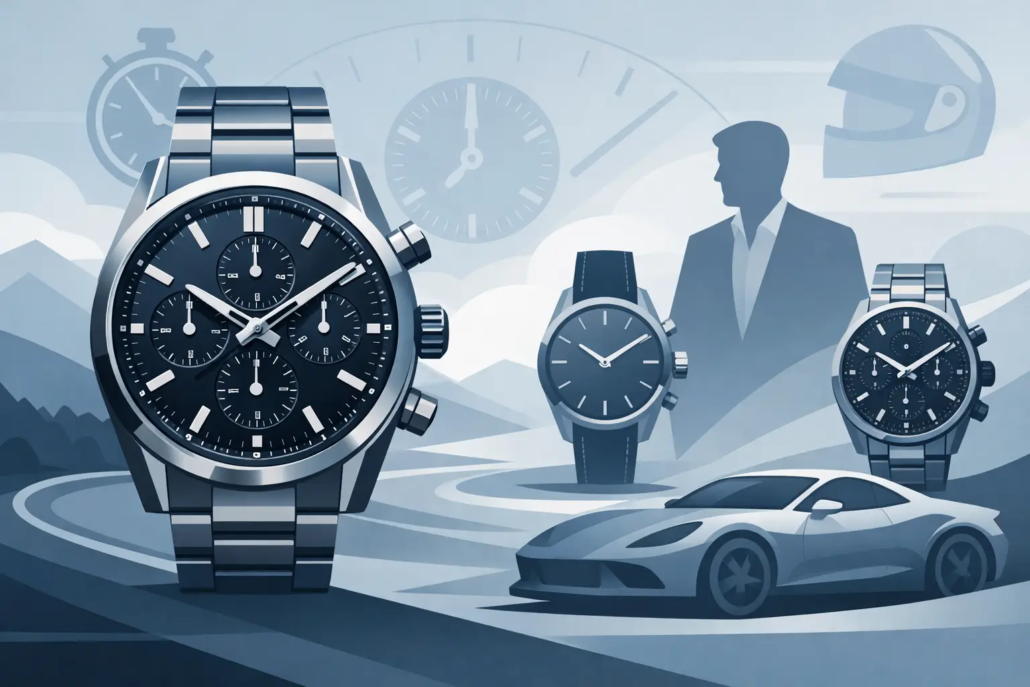
TAG Heuer Carrera: A Buyer’s Guide to the Icon
A TAG Heuer Carrera does not need a loud dial or oversized case to command attention. Its appeal comes from proportion, purpose, and a design language shaped by motorsport’s most demanding era. For the buyer who wants a prestigious Swiss watch with real heritage, but enough versatility for daily wear, the Carrera remains one of the strongest names in modern luxury watchmaking.
Introduced in 1963, the collection was conceived by Jack Heuer as a driver-focused chronograph inspired by the Carrera Panamericana road race. The original idea was straightforward: a clean, readable watch that could perform under pressure. More than six decades later, that clarity still defines the collection, even as the range has expanded to include automatic chronographs, refined three-hand models, openworked dials, tourbillons, and precious-metal editions.
Why the TAG Heuer Carrera Still Matters
Many sports watches rely on a recognizable bezel, a highly technical case shape, or a dramatic bracelet to establish their identity. The Carrera takes a more restrained route. Its signature is balance: a dial designed for legibility, pushers that feel integrated rather than decorative, and a case profile that works with tailoring as naturally as it does with a polo shirt or leather jacket.
This makes the Carrera especially compelling for collectors who want one watch to cover more than one setting. A racing chronograph has an obvious sporting character, yet a silver, black, blue, or deep green Carrera dial can remain polished enough for a boardroom, dinner reservation, or milestone event. It is a luxury watch with presence, not unnecessary noise.
The collection also carries a distinct position within the TAG Heuer universe. The Monaco is bold and unconventional, while the Aquaracer is built around aquatic capability. The Carrera is the brand’s architectural icon: motorsport-rooted, but fundamentally elegant.
Choosing the Right TAG Heuer Carrera
The best Carrera is not always the most complicated or most expensive reference. It depends on how you wear watches, what is already in your collection, and whether your priority is mechanical interest, visual impact, or all-day versatility.
Case size and wrist presence
Carrera cases are offered in a range of sizes, often from compact three-hand options around 36 mm to modern chronographs in the 42 mm range. The number alone does not tell the full story. Lug-to-lug length, case thickness, dial color, and bracelet choice all affect how substantial a watch feels on the wrist.
A 36 mm Carrera can be an excellent choice for smaller wrists, vintage-inspired proportions, or a more discreet luxury profile. Sizes around 39 mm to 41 mm are often the sweet spot for buyers seeking a balanced daily watch. A 42 mm chronograph offers greater dial space and a more assertive sporting stance, particularly on a steel bracelet.
If you favor formal clothing or own several larger sports watches, a slimmer Carrera with a clean dial can add welcome refinement to a collection. If your priority is a statement chronograph, a larger model with contrasting subdials or an openworked display will carry more visual energy.
Movement: mechanical character or quartz convenience
For many enthusiasts, the automatic chronograph is the heart of the Carrera experience. TAG Heuer’s Calibre Heuer 02 and newer TH20 movements offer a strong blend of modern engineering and collector appeal, typically with a long power reserve and a visible rotor through the caseback. These movements suit buyers who appreciate the ritual of mechanical watchmaking and the complexity behind a chronograph display.
A three-hand automatic Carrera presents a different proposition. With fewer dial elements and a thinner visual profile, it emphasizes clean design and daily practicality. It can be the better choice for someone who wants Swiss mechanical prestige without the added weight, thickness, or busier dial of a chronograph.
Quartz versions, where available, should not be dismissed automatically. They offer precision, low-maintenance ownership, and an accessible way into the Carrera design language. For a first luxury watch, a travel companion, or a gift intended for effortless use, quartz can be the practical answer. The trade-off is emotional rather than functional: it lacks the movement spectacle and traditional mechanical connection many collectors value.
Dial design and the personality of the watch
The Carrera has produced some of the most recognizable chronograph dials in contemporary watchmaking. A black dial with white registers feels technical and timeless. Blue adds depth without losing versatility. Green, copper, or sunburst finishes bring a more fashion-forward luxury presence, while skeletonized dials expose the mechanical architecture for buyers who want a more expressive watch.
Panda-style dials, with light backgrounds and dark subdials, have particular appeal because they recall classic racing chronographs. They are highly legible and unmistakably sporty, but they may feel less understated than a monochrome model. A clean black or silver Carrera is generally easier to wear every day. An openworked dial makes more sense as a centerpiece watch, especially for someone who enjoys explaining the mechanics on the wrist.
Dial choice also affects long-term satisfaction. Trend-driven colors can be exciting, and limited editions can add scarcity, but the most enduring purchase is usually the one you will still want to wear after the initial excitement has passed.
Chronograph, Date, or Three-Hand Simplicity?
The chronograph is the Carrera’s most natural format. Its pushers and subdials reflect the collection’s racing DNA, and it gives the watch a purposeful, instrument-like character. Even if you do not time laps or track driving intervals, the chronograph complication has a tactile pleasure: starting, stopping, and resetting it makes the watch feel alive.
Still, complications should earn their place. A date display is useful for daily professional wear, but its position can alter the symmetry of a dial. A three-hand Carrera offers the cleanest read at a glance and is often easier to pair with formal attire. A chronograph adds depth and heritage, though it will usually be thicker and visually busier.
For a first Carrera, a classic automatic chronograph is often the most satisfying choice because it captures the model’s original purpose. For a buyer building a considered collection, a restrained three-hand model may be the more strategic addition.
Bracelet or Leather Strap?
A stainless-steel bracelet makes the TAG Heuer Carrera feel more modern, durable, and versatile. It is the preferred option for buyers who want one watch for frequent wear, changing weather, and an active schedule. It also tends to offer the strongest visual value, since purchasing the original bracelet separately later can be expensive.
Leather changes the character immediately. On black, brown, blue, or perforated racing leather, the Carrera becomes warmer and more vintage-minded. It is especially attractive with a suit, a driving jacket, or evening attire. The compromise is that leather requires more care, particularly in heat or humidity.
The strongest approach is often to buy the watch on bracelet and add a quality strap later. That gives you a sportier daily configuration and the flexibility to create a more formal look when the occasion calls for it.
What Collectors Should Consider
A Carrera can be bought purely for style, but the collection rewards closer attention. Look at the specific movement, case dimensions, dial layout, bracelet construction, and whether a reference is a regular-production model or limited edition. Heritage-focused releases and designs that reference historic Carreras may appeal strongly to enthusiasts, while modern glassbox-inspired cases offer a distinctive curved crystal profile with vintage character and current finishing standards.
Limited editions can be attractive because of their rarity, special colors, or motorsport associations. Yet limited production alone does not guarantee lasting desirability. The strongest collector purchases combine a compelling design, a credible connection to the Carrera story, and a reference you would choose even without the limited-edition engraving.
Condition and completeness matter when purchasing pre-owned examples. Original box and papers, a matching bracelet, service history, and an unpolished or carefully maintained case can influence both confidence and future value. For a new watch, focus on authorized sourcing, warranty coverage, and the exact configuration shown in the product listing.
A Watch That Fits the Moment
The Carrera works because it has never abandoned the qualities that made it relevant in the first place: crisp legibility, racing credibility, and controlled elegance. It can mark a promotion, become a first serious Swiss watch, or hold its place in a collection beside divers, GMTs, and dress watches without feeling redundant.
Before choosing a reference, picture it on your wrist during an ordinary week, not only under boutique lighting. Consider its size, dial, movement, and strap as a complete expression of your style. If the right TAG Heuer Carrera is not currently in stock, the team at Relojes Exclusivos can help source a sought-after reference with the attention a significant watch purchase deserves.