How to Choose Pilot Watches With Lasting Style
A pilot watch should be easy to read before it is anything else. That principle came from aviation’s early instrument panels, where seconds, altitude, fuel, and direction had to be understood at a glance. Today’s pilot watches retain that visual authority, but they have also become some of the most versatile luxury timepieces to wear far beyond the cockpit.
For collectors, they offer heritage, purpose, and mechanical character. For a first premium watch purchase, they provide a confident alternative to a dive watch or dress model: practical enough for daily wear, distinctive enough to make an impression, and refined enough for business travel, dinner, or a major occasion.
What Defines a True Pilot Watch?
The aviation watch category is broader than its name suggests. Some models are faithful descendants of early military and civilian flight instruments, while others use the language of aviation in a more contemporary way. The best examples still share a common idea: legibility must lead the design.
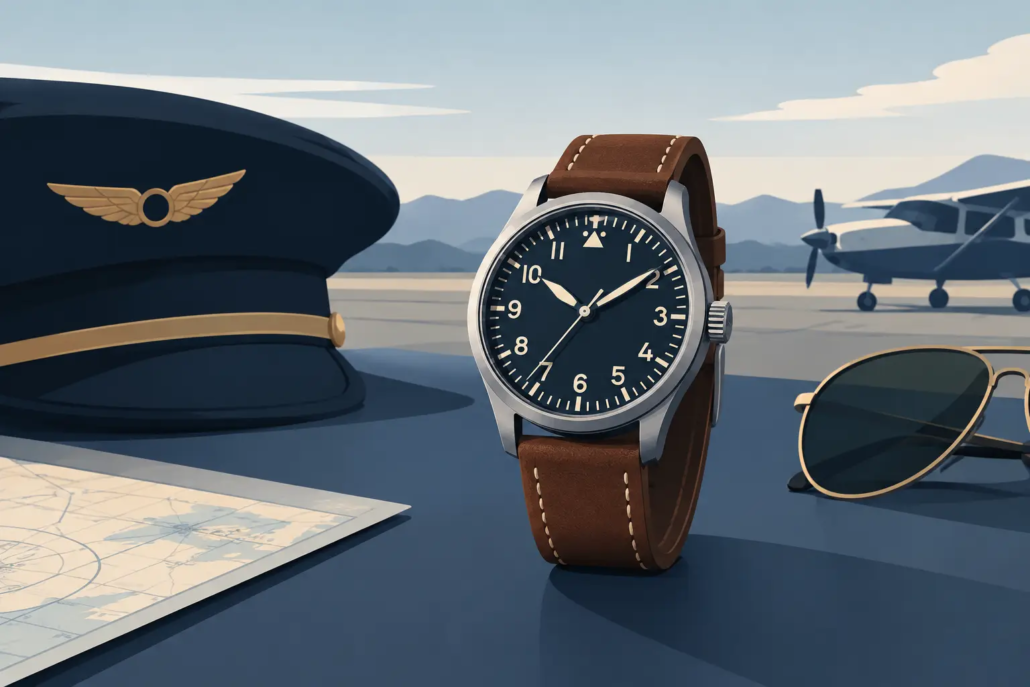
A classic pilot watch generally has a high-contrast dial, prominent Arabic numerals, luminous hands, and a large crown that can be operated with gloves. The case was historically oversized because pilots needed to read it quickly, often in low light and under difficult conditions. Modern versions are more wearable, with many excellent choices in the 39 mm to 43 mm range.
You will also see two historic dial families. Type A designs place large hour numerals around the dial with a simple minute track. Type B designs give more importance to the minutes, with an inner hour ring and a larger outer minute scale. Both have a strong vintage presence, though Type A is usually the easier choice for everyday versatility.
Pilot Watches: The Details Worth Paying For
Aviation style can be copied easily. Lasting quality is harder to replicate. When comparing premium pilot watches, look beyond the oversized crown and dark dial to assess the elements that determine how the watch will live on your wrist.
Dial clarity and lume
An excellent aviation dial feels calm, even when it carries complications. Numerals should be well spaced, the handset should stand apart from the dial, and the date window should not interrupt the design without purpose. White-on-black remains the essential cockpit combination, but deep blue, anthracite, green, and warm cream dials can bring a more individual character.
Luminous material matters if you travel frequently, drive at night, or simply appreciate a watch that remains useful after daylight fades. Look for generously applied lume on both hands and key markers. A bright dial may look dramatic in a product image, but contrast is the feature that matters most in real use.
Case size and wrist presence
The right size depends on your wrist, your wardrobe, and the watch’s lug-to-lug measurement. A 43 mm pilot watch can wear surprisingly well if the lugs curve sharply downward and the case is relatively thin. Conversely, a 41 mm model with long, straight lugs can feel much larger than expected.
If this is your only luxury watch, a 39 mm to 41 mm case is often the most flexible territory. It slips under a cuff, works with tailoring, and still delivers the purposeful presence expected from the category. Larger cases offer more visual drama and often suit collectors who want a truer instrument-watch profile.
Movement and useful complications
A three-hand automatic pilot watch is the purest expression of the category. It is uncomplicated, elegant, and easy to wear every day. A date display adds convenience without changing the character of the design, provided it is integrated neatly.
Chronographs are especially compelling in aviation-inspired collections. Their pushers, subdials, and timing scales create a more technical appearance, while models with a flyback function allow the chronograph to be reset and restarted with a single press. This is a meaningful feature for enthusiasts who appreciate mechanical ingenuity, even if they rarely time a flight plan.
GMT pilot watches deserve particular attention from frequent travelers. A dedicated 24-hour hand allows you to track home time while adjusting local time, making the complication genuinely useful on international trips. GPS solar models provide another modern interpretation, pairing aviation-minded accuracy with low-maintenance convenience. The choice comes down to what you value more: traditional mechanics, advanced functionality, or a balance of both.
Choosing the Right Aviation Style for Your Collection
The category has enough range to suit several different buying priorities. A heritage-focused watch with a matte dial, riveted leather strap, and oversized crown has the strongest historical appeal. It pairs naturally with denim, suede, knitwear, and relaxed tailoring, but may feel too casual for someone who wears formal business clothing most days.
A refined modern pilot watch takes a different route. Brushed and polished steel, a slimmer profile, a bracelet option, and a more restrained dial can make it an excellent office-to-evening piece. This is often the right direction for buyers who want aviation character without a purely military look.
For a more technical statement, consider a chronograph, GMT, or slide-rule bezel. These watches bring visual energy and collector appeal, especially from brands with established aviation credentials. Breitling remains a natural name for instrument-driven design and chronograph history, while TAG Heuer offers sport-forward precision with polished versatility. Oris and Alpina provide compelling options for buyers drawn to Swiss craftsmanship, practical engineering, and less obvious choices within a serious collection.
Seiko, Bulova, Luminox, Tissot, and Certina also demonstrate that a credible pilot watch does not need to occupy one price tier. The trade-off is usually found in movement finishing, materials, exclusivity, and brand positioning rather than basic usability. A well-chosen accessible model can be a highly satisfying daily watch, while a higher-value Swiss reference may offer greater refinement, a more elaborate caliber, or a more distinctive collector proposition.
Strap, Bracelet, and Everyday Wear
The strap changes a pilot watch more than many buyers expect. Leather is the traditional choice and gives the watch immediate warmth. Brown leather emphasizes vintage character, while black leather creates a sharper, more formal look. A textile strap feels lighter and more casual, particularly in warmer climates.
A steel bracelet adds versatility and can make a large aviation watch feel more contemporary. It is also the practical choice for frequent travel, humid conditions, and buyers who prefer a single watch that can handle almost any setting. If possible, choose a model with a quick-change system or compatible strap options. One excellent case can become several different watches in character.
Water resistance deserves a realistic view. Most pilot watches are built for daily life rather than diving. A rating suitable for rain, hand washing, and occasional splashes is enough for many owners. If you want a watch for swimming, boating, and travel without second thoughts, check the rating carefully rather than assuming an aviation design has the same water capability as a professional dive watch.
Why Heritage Still Matters
Aviation watches are not just styled objects. The strongest designs carry visual codes that were shaped by real demands: oversized numerals, anti-reflective crystals, legible hands, timing functions, and crowns designed for decisive use. That sense of purpose gives the category unusual staying power.
It also explains why pilot watches work so well as gifts and milestone purchases. They feel considered rather than decorative. A fine automatic movement, a well-proportioned case, and a dial that remains instantly recognizable create the kind of watch a buyer can wear for years and still notice with pleasure.
At Relojes Exclusivos, the most compelling choice is rarely the loudest model or the most complicated one. It is the pilot watch that fits your wrist, your travel habits, and the way you want to be seen. Choose the piece whose dial you will enjoy reading every day, then make it part of the journeys ahead.