How to Authenticate a Luxury Watch Before You Buy
A luxury watch can look convincing in a product photo and still tell the wrong story once it reaches your wrist. Knowing how to authenticate a luxury watch protects more than your investment: it protects the pleasure of owning a piece defined by precision, heritage, and exceptional craftsmanship. Whether you are considering a TAG Heuer chronograph, a Breitling pilot’s watch, or a limited-edition Hublot, authenticity should be established before price becomes the deciding factor.
Why authentication begins before the watch arrives
Counterfeit watches have evolved far beyond obvious misspellings and lightweight bracelets. Better replicas may copy a familiar dial layout, add a plausible serial number, and arrive in packaging that appears persuasive at first glance. Yet a luxury timepiece is a system of precisely matched details. The reference number, case architecture, movement, dial printing, finishing, documentation, and sales channel must all make sense together.
That is why authentication is not one single test. A genuine watch may have a worn box or no papers at all, particularly when it has been owned for years. Conversely, a pristine box and a stamped card do not make an incorrect watch genuine. Build confidence through several independent checks, and be especially careful when the price is dramatically below the usual market level. A rare opportunity exists from time to time, but an unexplained bargain deserves closer inspection.
How to authenticate a luxury watch step by step
Start with provenance and the complete set
Ask where the watch came from, when it was purchased, and whether it has been serviced. A credible seller should be able to answer clearly without changing the story. For a newer piece, look for the original warranty card, instruction booklet, presentation box, and purchase documentation. These items add value and support provenance, but they must correspond to the exact watch being sold.
Check that the reference on the warranty card matches the model and configuration in front of you. A black-dial chronograph, for example, should not be paired with paperwork for a blue-dial three-hand model. If a serial number is supplied, compare it with the serial on the case where the manufacturer places it. The location varies by brand and era, so never assume every watch follows the same format.
Original receipts and service records are particularly valuable for pre-owned luxury watches. They establish a more complete ownership trail and can reveal whether components were replaced. A factory service invoice may explain a new bezel, crystal, or bracelet, details that could otherwise raise questions during inspection.
Compare the reference, not just the appearance
Every established watchmaker works from a precise reference system. That reference identifies far more than the name on the dial: it can specify the case size, metal, dial color, bezel, bracelet, movement, and sometimes the exact production series. Search your brand’s official specifications or request a clear reference confirmation from the seller before committing.
Then compare the watch carefully. The dimensions should be correct. The subdials on a chronograph should sit in the proper positions. The date window, hands, indices, bezel scale, crown guards, and clasp should align with the reference. Limited editions require even more care, as a special caseback engraving or edition number should follow the manufacturer’s known style.
Do not reject a watch solely because a small detail differs from a current catalog image. Brands revise clasps, lume, casebacks, and bracelet construction during a model’s production life. What matters is whether the variation is documented for that reference and production period.
Inspect the dial, case, and finishing under magnification
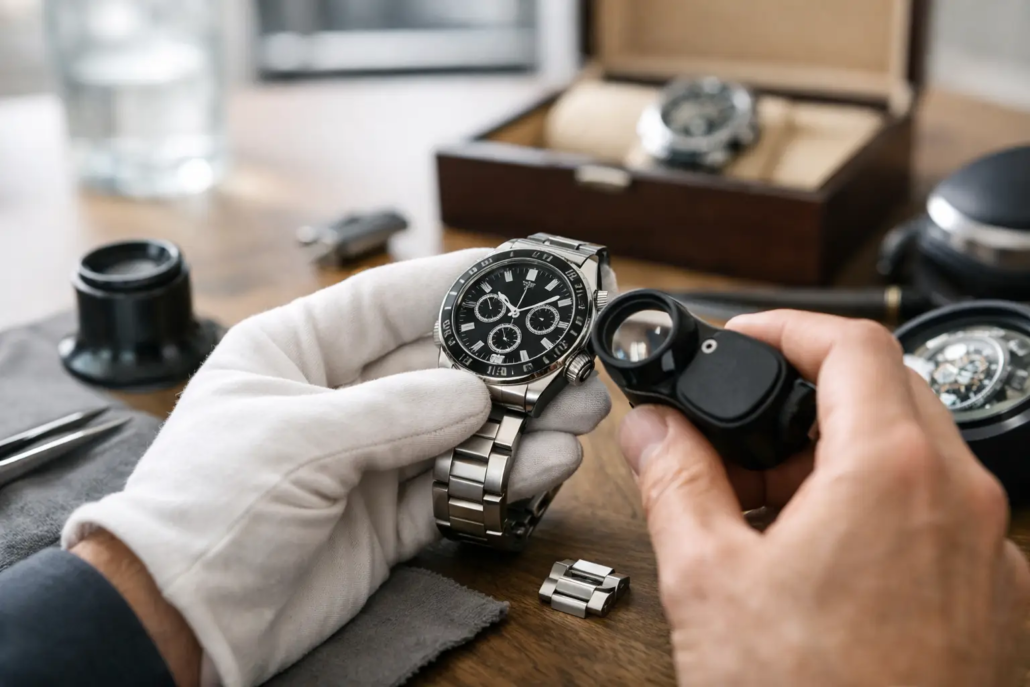
A close visual inspection often reveals the gap between imitation and haute horlogerie. Use a loupe or take high-resolution photographs in natural, indirect light. Examine the brand name, minute track, model text, and dial markings. On an authentic luxury watch, printing is generally crisp, evenly spaced, and correctly positioned. Letters should not bleed, look fuzzy, or sit unevenly against the dial furniture.
Look at the applied indices and hands as well. They should be cleanly fitted, properly aligned, and finished to a high standard. Luminous material should be neatly applied rather than spilling over edges. On polished and brushed surfaces, the transitions should appear deliberate and sharp. A counterfeit may imitate the overall silhouette but fail in these small areas of craftsmanship.
Weight can offer another useful clue, especially with steel sports watches and precious-metal pieces. However, it is not decisive by itself. Modern replicas can use convincing materials, while a genuine vintage watch may feel different after decades of service or replacement parts. Treat weight as supporting evidence, never the final verdict.
Verify the movement and its functions
The movement is the heart of the watch, and it is often the most revealing element. If the caseback is transparent, inspect the caliber, rotor, engraving, screws, bridges, and finishing. Compare them against reliable images and technical information for the specific reference. A genuine automatic movement should be appropriate for that model, not simply a movement with a familiar brand name added to it.
Function matters just as much. Test the crown action, winding feel, date change, chronograph pushers, GMT hand, and bezel operation where applicable. A chronograph should start, stop, and reset cleanly to zero. A diver’s bezel should turn in its intended direction with consistent clicks. An automatic watch can run outside ideal timing specifications if it needs service, but erratic operation is still a reason to pause.
Do not open a caseback yourself unless you are trained and equipped to do so. You risk damaging gaskets, scratching the case, or compromising water resistance. For a high-value purchase, an independent watchmaker can inspect the movement safely and assess whether it is original, correct, and in proper condition.
Assess the seller with the same rigor
The seller is part of the authentication process. A trusted specialist should provide accurate photographs of the actual watch, a full description of its condition, reference details, and a transparent return policy. Be cautious with stock images used for a supposedly pre-owned piece, heavily filtered photographs, or sellers who refuse to share images of the caseback, clasp, serial area, and paperwork.
A professional retailer also understands that questions about authenticity are expected. They should not pressure you to skip verification because another buyer is waiting. Limited stock can be real, especially for sought-after editions, but confidence should come from facts rather than urgency alone.
When a professional authentication is worth it
For a watch with a significant price, an unusual provenance, or a complicated movement, third-party inspection is a sensible final step. This is especially true with vintage pieces, discontinued references, and models that are frequently replicated. An experienced watchmaker can evaluate the caliber, case construction, dial originality, and signs of refinishing that may be difficult to identify from photographs.
Professional review can also distinguish between a counterfeit and a genuine watch with non-original parts. That distinction matters. A replacement crystal or service bracelet may be perfectly acceptable if disclosed and priced accordingly. A redial, incorrect movement, or fabricated caseback can affect collectibility and value far more seriously.
A quick pre-purchase checklist
Before you buy, make sure you can confirm these five points:
- The reference number matches the watch’s exact configuration.
- The serial, paperwork, and ownership history are consistent.
- Dial printing, case finishing, bracelet, and clasp meet brand standards.
- The movement and every advertised complication are correct for the reference.
- The seller provides clear information, real photographs, and a credible path for returns or expert inspection.
Common questions about authentic luxury watches
Can a serial number prove a watch is authentic?
No. A serial number can support authentication, but counterfeiters can copy genuine numbers. The number must be evaluated alongside the engraving quality, reference, documentation, movement, and the watch’s overall construction.
Is a watch without papers automatically suspicious?
Not automatically. Many older watches have lost their original documents over time. Lack of papers should affect the price and encourage deeper inspection, but it does not by itself prove the watch is counterfeit.
Can photos authenticate a luxury watch?
Photos can identify obvious inconsistencies and help you decide whether to proceed. They cannot always confirm movement originality, internal condition, or subtle refinishing. For a major purchase, hands-on inspection remains the stronger option.
The most desirable watch is not simply the one with the lowest price or the boldest design. It is the piece whose details stand up to scrutiny, whose provenance feels credible, and whose craftsmanship rewards a closer look every time you wear it.