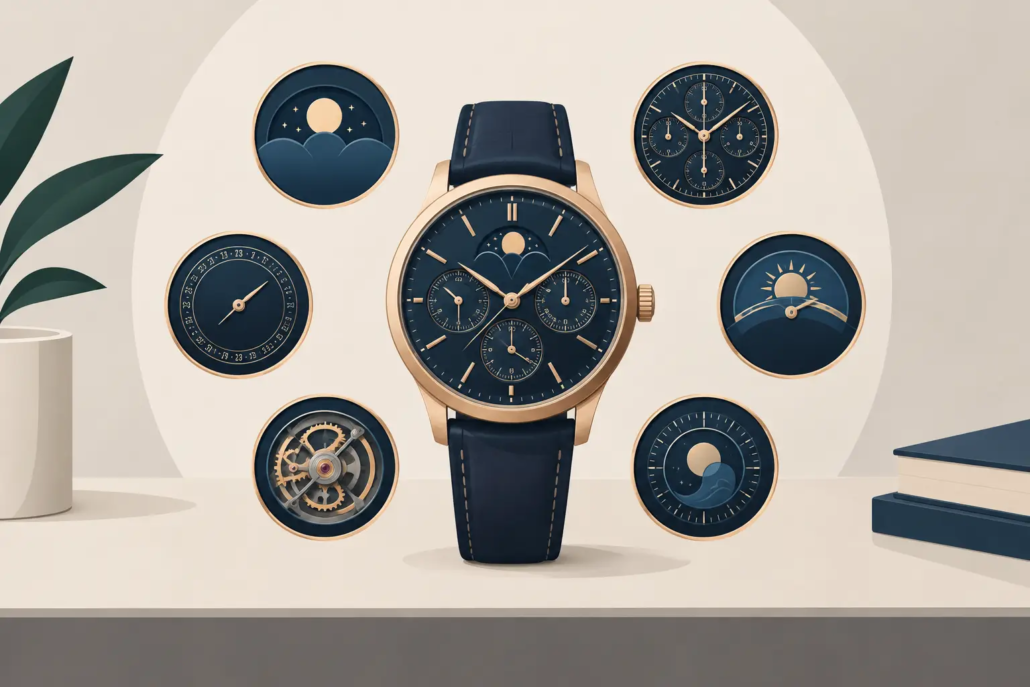
A Guide to Watch Complications Worth Owning
A watch complication is more than a technical talking point on a specification sheet. It is the function that can make a timepiece genuinely useful in your working week, more capable on a long-haul trip, or more compelling every time you turn it over and see the movement at work. This guide to watch complications focuses on the functions worth considering before choosing a premium watch, whether your preference is a sharp dress model, a serious diver, or an aviation-inspired chronograph.
In watchmaking, a complication is any function beyond the display of hours, minutes, and seconds. Some are designed for practical precision. Others exist to demonstrate exceptional mechanical craftsmanship. The right choice comes down to how you live with the watch, not simply how many subdials it has.
Why watch complications matter
Complications give a watch its character. A three-hand model can be beautifully pure, but adding a date window, second time zone, or chronograph transforms the dial and changes the relationship you have with the piece. It also affects the movement inside, the case proportions, the price, and often the maintenance required over time.
There is no universal «best» complication. A frequent traveler may get more value from a GMT than from a stopwatch. Someone buying a watch for formal events may prefer the restraint of a small seconds display or a moonphase. A collector may choose a perpetual calendar for the engineering alone, even if setting it requires care.
The strongest purchases balance usefulness with design. A complication should feel at home on the watch rather than crowding the dial simply to make it look more technical.
The everyday complications
Date and day-date
The date is the most familiar complication, and for many buyers it is the most practical. It may appear through a discreet window at three o’clock, within a framed aperture, or as part of a larger calendar display. A date complication is especially effective on an everyday steel sports watch or business-ready Swiss automatic, where quick readability matters.
A day-date adds the day of the week, usually through a second window. It has a more assertive visual presence and suits buyers who enjoy a classic executive look. The trade-off is simple: more information generally means a busier dial. If you favor a minimal, formal watch, a clean date window may be the better fit.
Power reserve
A power reserve indicator shows how much energy remains in a mechanical watch before it needs to be worn, wound, or placed on a winder. It is particularly useful on hand-wound watches and models with extended power reserves.
This complication has a distinctly mechanical appeal. Watching the indicator rise as you wind the crown creates a direct connection with the movement. On the other hand, it is less essential for a watch worn every day, since regular wrist motion keeps most automatic models running. Choose it for the experience and the visual detail, not because you expect it to replace good watch habits.
Small seconds and large date
Small seconds places the running seconds hand in a dedicated subdial, often at six or nine o’clock. It is a traditional detail that adds balance and a sense of heritage, particularly on dress watches and vintage-inspired designs.
A large date uses two date discs to create a more prominent display. It is exceptionally easy to read and can give a modern luxury watch a more architectural dial layout. Because the mechanism is more complex than a standard date, it often appears on higher-end references. The result can be striking, although it is not always the most subtle option.
A guide to watch complications for active lifestyles
Chronograph
The chronograph is one of the most recognizable complications in premium watchmaking. It allows you to measure elapsed time using pushers on the case and one or more chronograph hands or subdials. Its heritage is tied to motorsport, aviation, and sporting precision, which is why it remains central to collections from brands such as TAG Heuer, Breitling, and Tissot.
For daily use, a chronograph is more versatile than many people expect. It can time a presentation, parking meter, cooking session, or flight connection. More often, though, its appeal is visual. The pushers, subdials, and tachymeter scale create a confident, technical profile that works exceptionally well with a tailored jacket or casual weekend clothing.
Consider the thickness before purchasing. Chronograph movements are usually larger and more complex than three-hand movements, so the watch may sit higher on the wrist. If you wear close-fitting shirt cuffs, try a slimmer chronograph or a model with a more compact case diameter.
Dive timing bezel
A rotating bezel is not technically a movement complication, but it belongs in this conversation because it is one of the most useful functional features on a professional-style watch. A unidirectional dive bezel tracks elapsed minutes by aligning its marker with the minute hand.
Divers appreciate it for timing immersion, but its appeal extends far beyond the water. It is simple, instantly legible, and does not require pressing buttons. A well-executed dive watch brings rugged capability to everyday wear, especially when paired with strong water resistance, luminous markers, and a secure bracelet or rubber strap.
Alarm
A mechanical or electronic alarm is less common, which makes it appealing to collectors seeking something different. It can be useful for reminders while traveling or during meetings, but it is primarily a conversation-worthy expression of watchmaking ingenuity.
An alarm complication typically adds thickness and may produce a vibration or sound that feels modest compared with a phone notification. That is part of its charm. It is a purpose-built feature for someone who appreciates an object that performs its task independently of a screen.
Travel complications that earn their place
GMT and dual time
A GMT watch displays a second time zone, usually with an additional hand that completes one rotation every 24 hours. A 24-hour scale on the bezel or dial lets you distinguish day from night in your home city while tracking local time on the main hands.
This is among the most practical complications for international business, family abroad, and frequent travel. It is also one of the easiest to read once you understand the layout. A true GMT lets the local hour hand jump independently, an elegant advantage when crossing time zones. An office GMT usually adjusts the 24-hour hand instead, which may be perfectly suitable if you mainly monitor another location from home.
A dual-time display can perform a similar role with a second subdial or digital readout. Choose GMT for classic tool-watch appeal and immediate legibility. Choose dual time when you prefer a more refined or unconventional dial design.
World time
World time watches show multiple global time zones at once, typically through a city ring and 24-hour disc. Few complications communicate cosmopolitan confidence as effectively. They are ideal for buyers whose work, travel, or personal connections span continents.
The complication is visually rich, so it suits those who enjoy studying a dial. It is less restrained than a GMT and may be unnecessary for occasional travelers, but it offers remarkable presence and utility for the right owner.
High watchmaking complications
Annual calendar and perpetual calendar
A calendar complication becomes increasingly impressive as it requires fewer manual corrections. An annual calendar recognizes months with 30 or 31 days, so it needs adjustment only once a year at the end of February. It is a sophisticated step up from a conventional date.
A perpetual calendar goes further, accounting for varying month lengths and leap years. In theory, it can remain accurate for decades if kept running and correctly set. This is exceptional mechanical engineering, often presented with displays for the date, day, month, leap-year cycle, and sometimes moonphase.
The trade-off is ownership complexity. Perpetual calendars are delicate instruments, and incorrect adjustment can require professional attention. They are best for experienced collectors, careful owners, or anyone ready to keep the watch on a winder and follow its instructions precisely.
Moonphase
A moonphase tracks the lunar cycle through an aperture that reveals a rotating moon disc. It has little practical necessity in modern life, yet it remains one of the most romantic complications in watchmaking. On a refined dress watch, a moonphase introduces depth and poetry without losing elegance.
Some versions are highly accurate and need correction only after many years. Still, the real reason to choose one is emotional. It rewards a slower look at the dial, making it ideal for milestone gifts, formal wear, and collections built around craftsmanship rather than pure utility.
Tourbillon
A tourbillon places the escapement in a rotating cage, originally developed to counter the effects of gravity on pocket-watch accuracy. In a wristwatch, its practical accuracy advantage is debated, but its significance as a display of technical artistry is undeniable.
Tourbillons are typically expensive, visually dramatic, and intended for enthusiasts who value movement architecture. This is not a complication to buy because you need it. It is a statement of appreciation for rare finishing, precision assembly, and the theater of mechanical watchmaking.
How to choose the right complication
Start with the moments when you will wear the watch. If it will be your daily companion, date, GMT, or chronograph functions are the strongest candidates. If it will mark an anniversary, promotion, or major personal achievement, a moonphase, annual calendar, or open-worked complication may carry greater emotional weight.
Then consider readability. A complicated dial can be magnificent in product photography and less satisfying at a quick glance. Look at the contrast between hands and dial, the size of the numerals, and whether the function remains understandable without stopping to think. Prestige should never come at the expense of pleasure in wearing the watch.
Finally, respect the service commitment. More components can mean more specialized maintenance and higher servicing costs. That does not make advanced complications less desirable. It simply means the purchase should match your expectations as an owner.
At Relojes Exclusivos, the most rewarding choice is rarely the watch with the longest specification list. It is the one whose complication fits your routine, reflects your taste, and gives you a reason to look at your wrist long after you already know the time.