
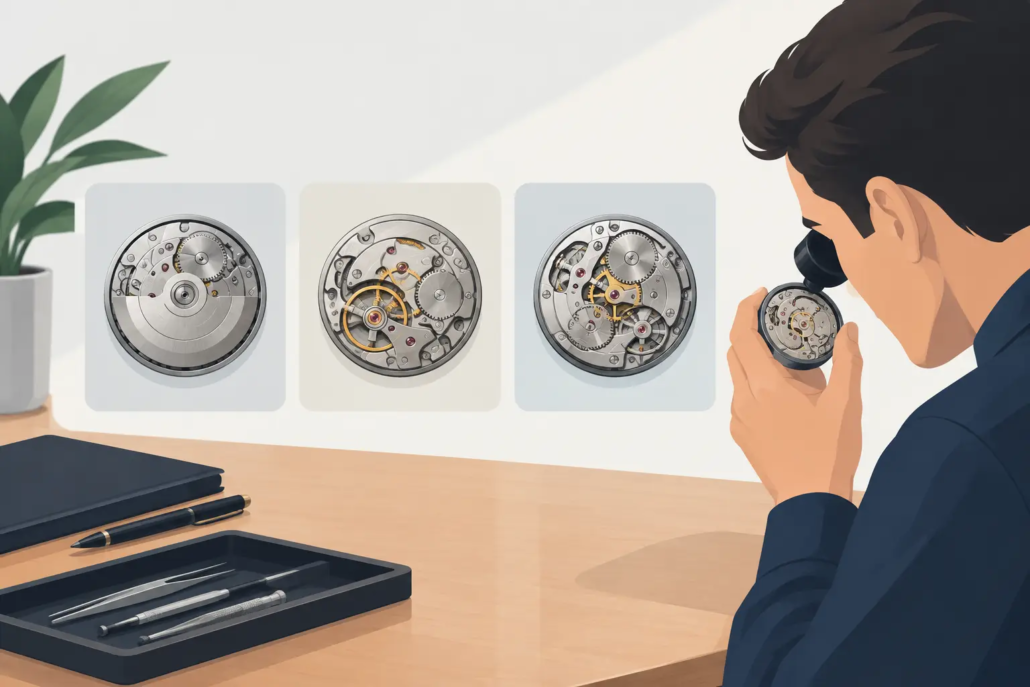
How to Compare Watch Movements Before You Buy
A polished case and famous name may catch your eye first, but the movement determines how a watch lives on your wrist. Learning how to compare watch movements lets you look beyond a specification sheet and choose a timepiece whose precision, character, and upkeep suit the way you actually wear it.
For one buyer, the right movement is a high-accuracy quartz caliber that is ready whenever a flight leaves early. For another, it is the quiet ritual of winding a hand-finished mechanical watch. Neither choice is automatically more prestigious. The better choice is the one that fits the watch’s purpose, price, and place in your collection.
Start With the Movement Type
The first comparison is straightforward: quartz, mechanical automatic, mechanical manual-wind, solar, or a more specialized hybrid system. Each creates a different ownership experience.
Quartz movements run on a battery and a vibrating quartz crystal. They are generally highly accurate, resistant to everyday knocks, and inexpensive to maintain. A quality quartz movement is not a compromise when its precision suits the watch. In a slim dress watch, a practical chronograph, or a refined everyday piece, it can be exactly the right engineering choice.
Mechanical movements are powered by a mainspring and regulated by a balance wheel. Automatic versions wind themselves through the motion of your wrist, while manual-wind calibers require regular winding through the crown. Their appeal is tactile and visual: the sweep of the seconds hand, the architecture visible through a caseback, and the connection to generations of watchmaking craft.
Solar movements convert light into stored energy, reducing the need for battery changes. GPS solar and radio-controlled systems add exceptional convenience for frequent travelers, often adjusting to highly precise reference time. These are particularly compelling in technical, aviation, and travel-focused watches, where functionality matters as much as tradition.
Do not assume mechanical always means better. A mechanical movement offers artistry and heritage; quartz and solar systems offer precision and convenience. Compare the movement to the intended role of the watch before comparing it to an idea of luxury.
How to Compare Watch Movements by Accuracy
Accuracy is the clearest performance measure, but it needs context. Most quartz watches gain or lose only seconds per month. High-accuracy quartz can perform even more tightly. Mechanical watches are commonly rated in seconds per day, and actual results vary with position, temperature, magnetism, and how the watch is worn.
A well-regulated automatic movement might run within a modest daily range that is entirely acceptable for a traditional luxury watch. A certified chronometer is tested to meet stricter accuracy standards, making it a strong signal of technical attention, though certification is not the only mark of a fine caliber.
For a watch worn occasionally, a few seconds each day may matter less than its design and mechanical appeal. For a professional who depends on exact time, or a collector who wants a grab-and-go piece, quartz, solar, or a highly regulated mechanical movement has a practical advantage.
Accuracy claims should also be read honestly. A published range is more useful than a vague statement that a movement is “precise.” Look for the stated tolerance, then remember that the best test is consistent real-world performance after the watch has been worn for several weeks.
Look Beyond the Number of Jewels
Jewels are synthetic rubies used at low-friction points in a movement. They reduce wear and support reliable operation, but a higher jewel count does not automatically mean a superior caliber. Extra jewels may be necessary for added complications or may simply reflect a particular movement design.
Instead, assess the movement as a complete system. Consider its power reserve, beat rate, complication layout, thickness, and reputation for long-term reliability. A movement with 25 jewels and a proven service history can be a stronger proposition than one with a more dramatic number on the dial or product page.
Power reserve tells you how long a fully wound mechanical watch will run when it is not being worn. Around 38 to 42 hours remains common and perfectly workable for a daily automatic. Reserves of 60, 70, or more hours offer useful flexibility, especially if you rotate several watches. The trade-off can be a thicker movement or a more complex winding system, so more reserve is valuable, not automatically decisive.
Beat rate, expressed in vibrations per hour, influences the seconds hand’s visual sweep and the movement’s behavior. Higher-frequency movements can offer greater stability in some conditions, but they may demand more energy and sometimes more attentive servicing. Lower-frequency calibers can have a more traditional rhythm and often appeal to collectors who value classic construction. The caliber’s execution matters more than choosing a winner based on frequency alone.
Compare Complications for Real Use
A complication is any function beyond basic hours, minutes, and seconds. The finest complication is not necessarily the most elaborate one. It is the one you will use.
A date display adds daily convenience, but placement matters. A discreet date at six o’clock can preserve a dress watch’s symmetry, while a larger aperture may be better suited to an active watch. GMT functionality is ideal for international business, travel, or tracking family across time zones. A true GMT, with an independently adjustable local hour hand, is especially convenient when crossing borders.
Chronographs bring sporting heritage and visual energy, but they also make a movement more complex. Compare the operating feel of the pushers, the readability of the subdials, and whether you want a classic two-register layout or fuller timing capability. Dive watches benefit from uncompromised water resistance and legibility more than a crowded dial of functions that will never be used underwater.
Annual calendars, moon phases, perpetual calendars, and tourbillons represent serious watchmaking, yet they require a buyer who appreciates both their craft and their demands. Complications can raise service costs and introduce more components to regulate. For a first premium watch, a dependable time-and-date movement is often the most satisfying place to begin.
In-House, Manufacture, and Proven Movement Platforms
Movement terminology can be confusing. “In-house” usually means a brand designs and produces a movement within its own organization, but the level of internal manufacturing varies. “Manufacture” can suggest a higher degree of proprietary production, though definitions are not universally standardized.
A proprietary caliber may offer a distinctive architecture, an extended power reserve, or a complication designed around a particular collection. It can make a watch feel more exclusive, particularly in a limited production reference. Yet a respected movement platform supplied by a specialist manufacturer can be equally desirable. These movements are often well tested, familiar to experienced watchmakers, and supported by an established service network.
The question is not simply who made it. Ask whether the movement is appropriate for the watch, proven over time, and supportable where you live. A decorated exclusive caliber has collector appeal. A dependable, widely serviced automatic may be the more sensible choice for an everyday luxury watch.
Assess Finishing Without Being Distracted by It
Finishing is where mechanical movements become objects of visual appreciation. Through a sapphire caseback, look for cleanly applied striping, perlage, polished bevels, blued screws, engraved rotors, and carefully finished bridges. These details require skill and elevate the sense of craftsmanship.
But finishing should be judged at the price level and against the watch’s purpose. A rugged tool watch is not diminished because its movement is finished for durability rather than spectacle. Conversely, when a watch is positioned as refined, skeletonized, or high horology, the movement should reward close inspection with confident execution.
Decoration cannot correct weak engineering, and plain finishing does not indicate poor performance. The strongest watches align their movement presentation with their identity: technical where they need to be technical, expressive where they promise artistry.
Factor In Service, Durability, and Ownership Cost
Every movement eventually needs attention. Quartz watches need battery changes unless they are solar-powered, along with periodic water-resistance checks. Mechanical watches require complete servicing at intervals determined by the brand, the movement, and how the watch is used. Heavy exposure to water, shocks, magnetism, or infrequent wear can change that timetable.
Before buying, consider access to authorized service, availability of parts, and the likely complexity of the caliber. A simple three-hand automatic is usually less expensive to maintain than a chronograph, annual calendar, or perpetual calendar. This is not a reason to avoid complications. It is a reason to buy them with clear expectations.
Water resistance is related to movement protection, too. A screw-down crown, secure case construction, and regularly inspected seals help protect the caliber from moisture. If the watch is intended for swimming or diving, follow its stated rating and have its seals tested periodically. A beautiful movement deserves practical care.
Choose the Movement That Makes You Want to Wear the Watch
The most satisfying comparison ends with a personal decision, not a technical scorecard. A collector may choose a manual-wind watch for its visible mechanics and daily ritual. A frequent traveler may favor a GMT automatic or GPS solar model. A first-time luxury buyer may want the assurance of a proven automatic caliber with a date and a strong service record.
Compare specifications carefully, but give equal weight to the feeling of the watch in use: the crown action, the pusher response, the balance of the case, and the confidence that it will suit your day. At Relojes Exclusivos, a well-chosen movement is not hidden beneath the dial. It is the enduring reason a distinguished watch becomes part of your life.