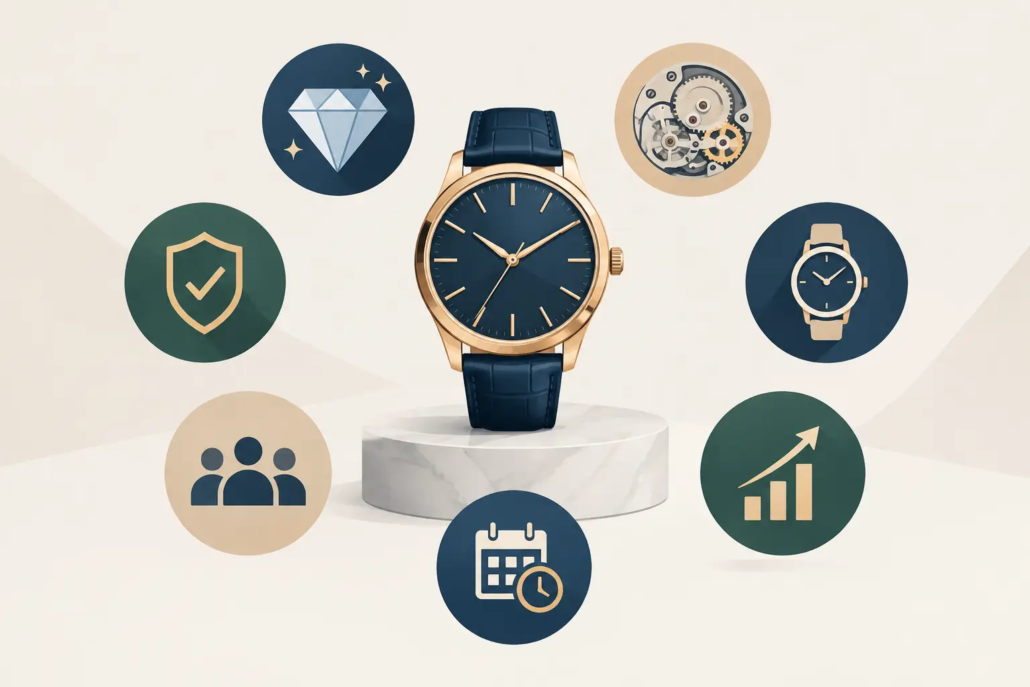
What Makes a Watch Valuable? 7 Key Factors
A watch can cost a few hundred dollars or command the price of a luxury car, yet both may tell time with impressive accuracy. So, what makes a watch valuable? The answer is rarely a single detail. Real value comes from the meeting point of watchmaking pedigree, technical substance, condition, rarity, desirability, and the emotional pull of a design that people recognize instantly.
For some buyers, value means a finely made watch that elevates a tailored suit or becomes a trusted daily companion. For collectors, it may mean a discontinued reference, an unusual dial, or a mechanical movement with genuine historical significance. Understanding the difference helps you buy with confidence, whether you are choosing your first Swiss automatic or adding a serious piece to an established collection.
What Makes a Watch Valuable Beyond Its Price?
Retail price is the starting point, not the final word. A high price can reflect precious materials, a celebrated brand name, limited production, or sophisticated complications. But long-term desirability depends on whether those qualities matter to buyers after the watch leaves the boutique.
A strong luxury watch brings together quality that can be felt and a story that can be understood. The reassuring action of a signed crown, the precision of a chronograph pusher, the finishing of a case, and the balance of a well-proportioned dial all contribute to its presence. These details do not guarantee future appreciation, but they do distinguish a serious timepiece from an expensive accessory.
The most compelling watches also have a clear identity. A professional dive watch should look ready for the sea. An aviation model should feel legible, purposeful, and instrument-inspired. A dress watch should bring restraint, elegance, and proportion. When design and purpose align, a watch tends to remain relevant long after seasonal trends have passed.
1. Brand Heritage and Recognition
Established watchmakers carry value because their names represent years, and often generations, of technical achievement and distinctive design. Brands such as TAG Heuer, Breitling, Oris, Seiko, Tissot, and Hublot each speak to different parts of the market, from racing chronographs and pilot watches to refined sports pieces and bold contemporary luxury.
Heritage is not just a logo on a dial. It can include a brand’s connection to diving, aviation, motorsport, exploration, or precision timing. A model family with a recognizable history often has greater staying power because buyers know what it represents. That heritage also makes the watch easier to discuss, compare, and eventually sell.
Recognition matters, but it is not everything. Some independent and enthusiast-focused brands offer exceptional finishing, inventive mechanics, or distinctive styling at a price that larger names cannot match. Their value may be more personal and collector-driven rather than universally recognized. The right choice depends on whether you prioritize broad market appeal or a more individual point of view.
2. Movement Quality and Mechanical Interest
The movement is the engine of the watch, and it has a major influence on how a timepiece is perceived. Mechanical calibers appeal because they transform stored energy into timekeeping through springs, gears, levers, and careful adjustment. An automatic movement adds the practical pleasure of winding through the motion of the wrist, while a manual-wind caliber offers a more direct ritual between owner and watch.
Not every valuable watch must be mechanical. High-accuracy quartz, GPS solar, and advanced electronic movements can deliver extraordinary practicality, particularly for travel, outdoor use, or daily wear. A solar-powered GPS watch may be more useful than a traditional mechanical piece for some owners. However, mechanical watches generally carry greater emotional and collector appeal because of the craft involved in their construction and serviceability.
Complications can add another dimension of value when they serve a real purpose or are executed with distinction. Chronographs, GMT functions, moon phases, perpetual calendars, and tourbillons require added engineering and usually more involved assembly. Still, complexity alone is not enough. A cleanly designed GMT from a respected maker can be more desirable than an overloaded watch whose functions feel disconnected from its character.
3. Materials, Finishing, and Proportion
Luxury is often visible in the details that photographs only partly capture. Case material, bracelet construction, crystal quality, dial texture, lume application, and clasp engineering all affect how a watch wears and ages. Stainless steel remains one of the most sought-after materials because it is versatile, durable, and appropriate in almost any setting. Titanium offers lightness and a technical edge, while gold and platinum bring undeniable presence and intrinsic material value.
Finishing separates an ordinary case from one that rewards close inspection. Crisp transitions between brushed and polished surfaces, an even bezel action, deeply engraved markings, and a carefully integrated bracelet signal considered manufacturing. On the dial, applied indices, layered construction, sunburst finishing, skeletonized architecture, and balanced typography can create a level of sophistication that lasts.
Proportion is equally important. A large case in a trend-driven shape may attract attention now but date quickly. A well-sized 39 mm or 40 mm sports watch, or an elegant slim dress model, often has a broader and more enduring audience. The best dimensions are not determined by fashion alone. They depend on wrist size, case thickness, lug-to-lug length, and the watch’s intended role.
4. Rarity, Limited Editions, and Reference Details
Scarcity can increase a watch’s desirability, but only when there is genuine demand behind it. A limited edition tied to a meaningful anniversary, a racing partnership, a historic design, or a respected technical achievement may hold strong appeal. Limited production without a compelling story is less persuasive.
Collectors often look beyond the model name to the exact reference, dial variation, bezel configuration, bracelet, and production period. A discontinued reference can become more sought-after if it has a distinctive profile or marks the end of a beloved design era. Small details matter: a particular colorway, an original signed bracelet, a rare complication, or a short production run can all separate one example from another.
That said, “limited edition” should never replace personal taste. Buy the watch because you would be pleased to wear it if market interest stayed flat. Rarity can support value, but it cannot create lasting appeal on its own.
5. Condition, Originality, and Complete Set
Two examples of the same reference can have very different values. Condition is often the deciding factor. A sharp case with intact lines, a clean dial, a properly functioning movement, and an original bracelet will generally be more desirable than a heavily polished, damaged, or incomplete example.
Originality matters especially in collectible watches. Replacement hands, refinished dials, incorrect bezels, or non-original components can affect both collector confidence and resale potential. On modern watches, the full set also carries weight: original box, warranty card, manuals, tags, spare links, and service documentation help establish provenance and make a future sale easier.
A watch does not need to be unworn to be valuable. In fact, an honest, well-cared-for watch with light signs of use can be an excellent purchase. The key is transparency. Understand what has been polished, replaced, serviced, or altered before deciding what the piece is worth to you.
6. Market Demand and Cultural Relevance
Watch values are shaped by people as much as by specifications. A reference with a loyal collector community, strong visibility, and a recognizable design language can maintain demand even as tastes change. Cultural associations with motorsport, cinema, exploration, sport, or notable public figures can also give a model greater resonance.
Market demand can move quickly, particularly for headline luxury references. Some watches trade above retail during periods of intense interest, then return closer to their original price as availability improves. This is why it is wise to separate a watch’s collectible potential from short-term hype. Prestige, craftsmanship, and personal enjoyment are more dependable reasons to buy than the expectation of a quick return.
For buyers who want versatility, iconic sports watches from established makers are often a considered choice. For those seeking individuality, a skeletonized piece, heritage-inspired diver, colorful chronograph, or refined independent design may offer more character at the same budget.
7. The Value That Only the Owner Can Define
The final measure of value is personal. A watch received for a graduation, promotion, wedding, or major achievement carries a history that cannot be measured by a market chart. The model you wear through years of travel, work, and celebration can become more meaningful than a rarer reference kept in a safe.
At Relojes Exclusivos, the strongest choices are often the ones that combine recognizable watchmaking substance with a design you will want to wear repeatedly. Consider the brand’s heritage, the movement, the condition, and the market, then trust your eye. A valuable watch should feel exceptional every time you fasten it to your wrist.