Are Watch Winders Worth It for Your Collection?
A fine automatic watch is designed to be worn, not left forgotten in a drawer. Yet a collector may rotate between a Breitling chronograph, an Oris diver, a refined TAG Heuer, and a special-occasion dress watch throughout the month. Watch winders offer a considered way to keep selected mechanical pieces running, correctly displayed, and ready when the moment calls for them.
They are not essential for every watch or every owner. The right choice depends on the movement inside the case, the complications you use, how often you wear the watch, and the role it plays in your collection. A quality winder is a convenience accessory, but for the right automatic timepiece, it can be a very practical one.
What watch winders actually do
An automatic mechanical watch stores energy in its mainspring as the rotor moves with your wrist. When the watch is not worn, that stored energy gradually runs out. Most automatic watches will stop after roughly 38 to 72 hours, although certain modern calibers offer longer power reserves.
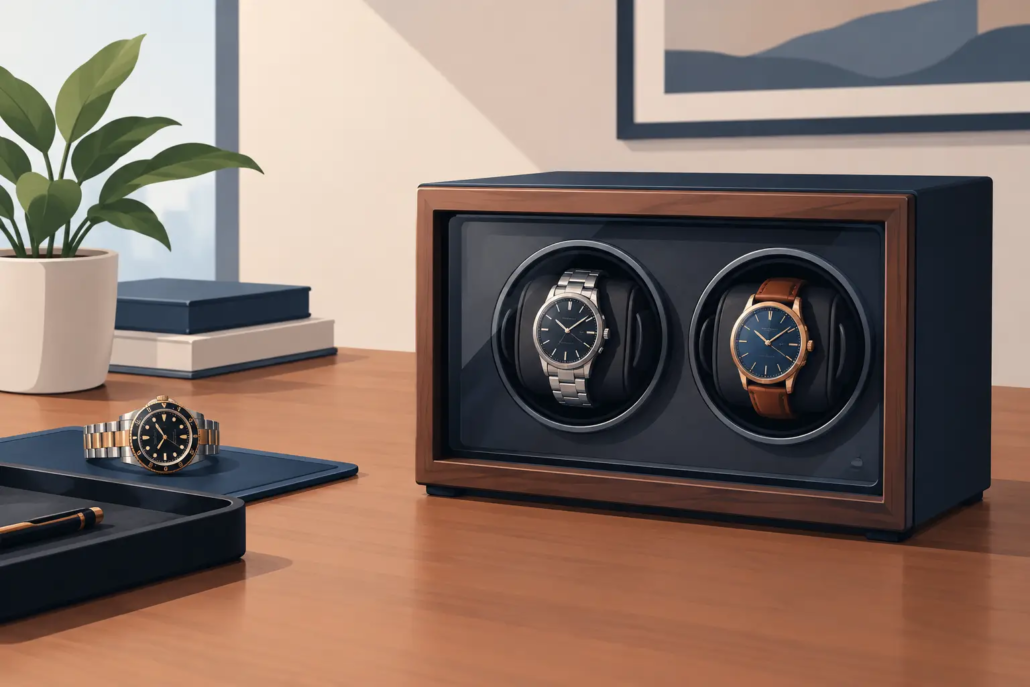
Watch winders gently rotate the watch at programmed intervals to replicate normal wrist motion. This keeps the mainspring sufficiently charged, allowing the watch to continue running while it is off your wrist. A well-chosen unit does not spin constantly. It rests between cycles and follows settings designed for the needs of mechanical movements.
The main attraction is immediate wearability. Pick up a watch from the winder and it should already show the correct time, with the date and other functions still operating. That benefit is especially valuable with watches that feature annual calendars, moon phases, multiple time zones, or other displays that take time to reset accurately.
A winder also gives prized pieces a dedicated place in a collection. Premium models often combine soft interior cushions, secure compartments, quiet motors, and elegant cases in wood, leather, or glass. On a dresser, in a wardrobe, or inside a safe, the presentation can feel as considered as the watches themselves.
When a watch winder makes sense
A watch winder is most useful for an automatic watch you wear regularly but not daily. Perhaps your workweek calls for a clean steel three-hand watch, while weekends are reserved for a professional dive model or a GMT. Rather than winding and setting each piece whenever you switch, a winder keeps your preferred rotation ready.
It is particularly worthwhile for complicated watches. Resetting the date on a straightforward automatic model takes moments. Resetting a perpetual calendar, a moon-phase display, or a calendar chronograph can be far more involved. In some cases, incorrect date adjustment during restricted hours can even create avoidable stress on the movement. Keeping that watch running may be the easier and more elegant option.
Frequent travelers may also appreciate a winder for a home-based watch with date and GMT functions. When you return, your chosen watch is already operating and prepared for a quick time-zone adjustment.
There is also an emotional case. A limited edition, a gifted watch, or a significant purchase deserves better than being placed loose in a drawer. A winder can make a small collection feel more intentional while protecting the watch from unnecessary contact with other objects.
Still, ownership alone is not a reason to buy one. If you wear an automatic watch almost every day, your wrist does the work. If a watch is worn only once or twice a year, it can simply be stored safely and wound when the occasion arrives. Mechanical watches are built to stop and start. A winder is about convenience, not a requirement for basic care.
Which watches should stay off a winder
Never place a quartz watch on a winder. It has no mechanical rotor to wind, so rotation serves no purpose. The same applies to many solar-powered, GPS solar, and battery-operated models. These watches should be stored according to their own power and light-exposure requirements.
Manual-wind watches should also remain off a winder. They need to be wound through the crown by hand, and the rotating cushion cannot add power to the mainspring.
For automatic watches, check the brand’s instructions before choosing a setting. Most modern movements include a slipping bridle that prevents normal winding from over-tightening the mainspring. However, that does not mean every watch benefits from permanent motion. Vintage watches, delicate heirlooms, and pieces awaiting service deserve more caution. If in doubt, consult an authorized watchmaker familiar with the movement.
A winder also cannot correct an existing problem. If a watch loses substantial time, stops unexpectedly, or has moisture under the crystal, service should come before storage on a rotating device.
How to choose a watch winder
The most expensive winder is not automatically the best fit. Start with compatibility and control. Your automatic watch movement has a preferred number of turns per day, commonly referred to as TPD, plus a preferred rotation direction: clockwise, counterclockwise, or alternating.
A good winder lets you select those settings rather than forcing every watch into one generic pattern. Adjustable programs are especially valuable for a multi-brand collection, since a Seiko automatic, a Swiss chronograph, and a high-complication luxury piece may have different needs.
Consider these points before selecting a model:
- Capacity should match your realistic collection, not only the watches you own today. A single winder is ideal for one daily rotation; a multi-watch cabinet suits collectors who alternate several automatic pieces.
- The cuff must hold the bracelet or strap securely without stretching it. Oversized dive watches and smaller dress watches can require different cushion sizes.
- Quiet operation matters. A winder placed near a bedroom or office should be nearly silent during its cycles.
- A reliable power system adds flexibility. AC operation is useful at home, while battery capability can be helpful inside a safe or during travel.
- Build quality matters as much as appearance. Look for stable construction, a protected interior, and a door or cover that keeps dust away from the watch.
Avoid models that rotate continuously at high speed with no programmable rest periods. More motion is not better. The goal is to maintain sufficient power reserve with controlled, appropriate activity.
Setting a winder with care
Begin with the movement specifications supplied by the watch manufacturer. If the information is unavailable, start conservatively with a low or medium turns-per-day setting and alternating direction. Observe whether the watch remains powered and maintains its reserve over several days. If it stops, increase the setting gradually rather than jumping to the maximum.
Make sure the watch is secure on the cuff and that the crown is fully pushed in or screwed down, as appropriate. For a dive watch, confirm the screw-down crown is properly sealed before storage. A winder will not compromise water resistance, but good habits protect a watch long after it leaves your wrist.
Keep the unit away from direct sunlight, excessive heat, humidity, and strong magnetic sources. Modern watches often have improved magnetic resistance, but thoughtful storage remains part of owning a precision instrument. If you keep watches in a safe, choose a compact winder with dependable battery power or a carefully planned power solution.
Even watches kept on winders still need regular attention. Wipe the case and bracelet with a soft cloth, inspect leather straps for wear, and follow the manufacturer’s service guidance. A winder maintains motion. It does not replace careful ownership or professional maintenance.
A refined accessory for the right collection
For collectors who enjoy rotating automatic watches, a winder turns a small daily task into a ready-to-wear ritual. It preserves the convenience of a running movement, supports complex displays, and presents exceptional timepieces with the respect their craftsmanship deserves.
Choose settings that suit the movement, buy for quality rather than excess capacity, and reserve the winder for watches that genuinely benefit from it. Then, when a meeting, flight, celebration, or weekend escape calls for a different watch, your next choice will be waiting.