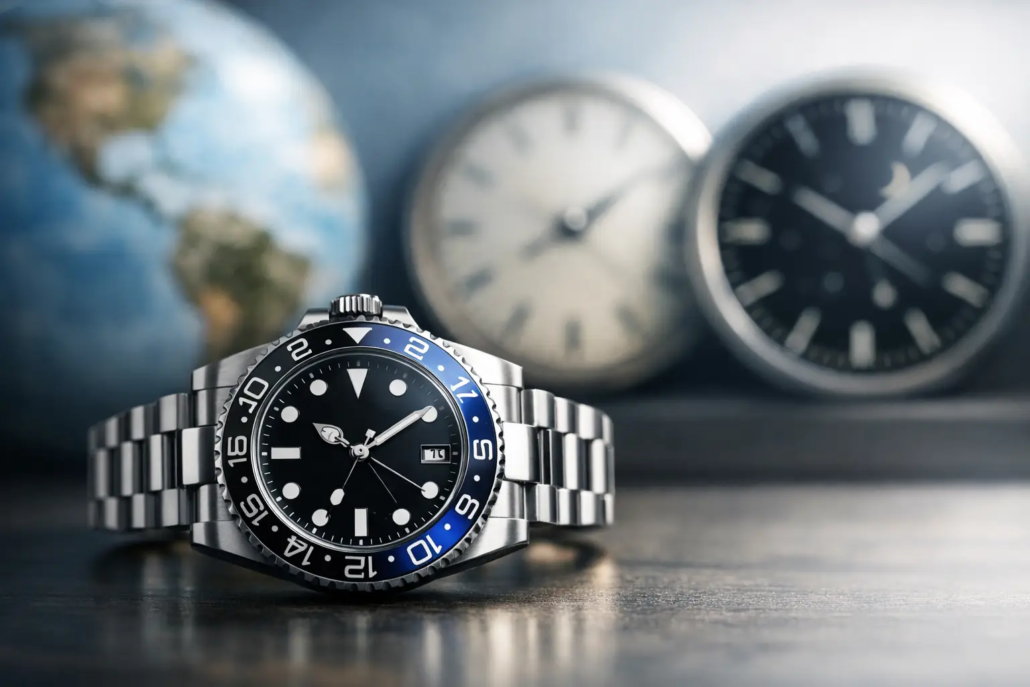
How GMT Watches Track Time Zones
In a high-end watch, the GMT function is not merely ornamental. It is a complication originally designed for pilots and travelers, later adopted by executives, collectors, and enthusiasts who appreciate the technical utility of a well-executed dial. It allows you to read two time zones at a glance, and in certain configurations even a third, without relying on your mobile phone.
How GMT Watches Track Multiple Time Zones
A conventional GMT watch displays local time using the usual hour, minute, and second hands. The difference lies in a fourth hand, usually recognizable by its contrasting color, arrowhead, or distinct design. This GMT hand completes a full rotation in 24 hours, not 12.
This slower rotation is read on a 24-hour graduated scale. This scale may be printed on the flange or around the perimeter of the dial, although on many sports and aviation watches it appears on an external rotating bezel. Thus, when the GMT hand points to the 15, it indicates 3:00 PM in the selected time zone, while the conventional hour hand may point to a different local time.
The relationship between the two is simple. If it is 10:00 AM in Madrid and you want to track New York time, which is six hours behind for much of the year, the GMT hand might point to 4:00 AM on the 24-hour scale. The dial continues to display 10:00 AM local time as usual. This reading avoids a common confusion: 4:00 and 16:00 share the same position on a 12-hour dial, but not on a 24-hour GMT scale.
The 24-hour format also makes it easy to distinguish between day and night. For those who coordinate international meetings, await calls from Asia, or travel frequently, this distinction is immediately useful. A well-executed GMT complication makes time information legible, discreet, and a constant presence on the wrist.
The GMT Hand and the 24-Hour Scale
The additional hand is usually linked to the movement’s gear train to advance exactly half as fast as the hour hand. In a quality automatic model, this operation depends on precise mechanical tolerances, a robust construction, and proper caliber adjustment.
Not all GMTs present information in the same way. A simple dial might incorporate an inner scale in understated tones, ideal for a classic timepiece. A sports watch might feature a two-tone 24-hour bezel, offering high contrast and a distinctive aesthetic. In both cases, the priority is the same: that the second time zone be intuitive without sacrificing proportion, elegance, or legibility.
In luxury watchmaking, the choice of materials also enhances the experience. A ceramic bezel resists visual wear very well; steel adds presence and versatility; sapphire crystal protects the dial’s readability. Aesthetics matter, but it’s best to first consider which configuration is most comfortable for your intended use.
Two Types of GMT: Traveler and Office
The most relevant technical difference isn’t the color of the hand, but which hand is adjusted independently. That’s why we commonly talk about Traveler GMT and Office GMT, two valid approaches with different uses.
In a Traveler GMT, also called true GMT or flyer GMT, the local time hand can be advanced or delayed in one-hour increments. The GMT hand remains fixed on home time. This is the most convenient configuration for those crossing borders: upon landing, the local time is adjusted without stopping the watch or changing the minutes. If the calendar is linked to the home time, the date will also advance or set back after midnight.
In an Office GMT, the GMT hand is the one that is adjusted independently. The home time remains the primary reference, and the second hand is set to the time of a headquarters, a family member, or an international client. For a professional working from Spain with international markets, this solution is usually more than sufficient and often provides access to very attractive automatic GMT changes within a more affordable price range.
Neither is objectively superior in all cases. Traveler GMT offers a more refined experience for frequent flights; Office GMT can be an excellent choice if the second time zone is checked more often than it’s changed. The decision should be based on actual usage, not just the technical specifications.
The rotating bezel allows you to add a third time zone reference.
When a watch incorporates a bidirectional rotating GMT bezel, the complication gains an additional layer of utility. The GMT hand continues to display one time zone on the 24-hour scale, but by rotating the bezel, that scale can be shifted to display another time zone.
For example, with Madrid as the local time and New York set on the GMT hand, the bezel can be aligned with Tokyo to calculate a third time zone reference. This isn’t three independent timekeeping mechanisms: it’s a reading calculated from the same GMT hand and a rotating scale. Even so, it’s especially practical on days with meetings spread across Europe, America, and Asia.
The downside is that it requires knowing the time difference between cities. A 24-hour bezel doesn’t automatically calculate seasonal changes. When daylight saving time begins or ends, the position of the GMT hand or the bezel must be adjusted accordingly.
Important limitations to know:
A GMT watch is not a substitute for a time zone database. Time zone differences change with daylight saving time, and not all countries adjust their clocks on the same date. Furthermore, some territories, like India and Nepal, have time zone differences of half an hour or 45 minutes, which don’t perfectly align with traditional time zone changes.
It’s also worth remembering that a GMT function is not equivalent to world time. A world time watch is designed to simultaneously display multiple cities and their respective time zones using a disc or ring of locations. GMT, on the other hand, prioritizes a clearer reading of two essential time zones, with the option of a third via the bezel. For many collectors, this simplicity is precisely part of its appeal.
How to Adjust a GMT Watch Accurately
Before adjusting the crown, consult the specific manual for your movement. On watches with a screw-down crown, unscrew it gently and avoid adjusting the time underwater. Water resistance protects the watch when the crown is fully closed, not during a time correction.
First, set the reference time, usually your home or headquarters time. Position the GMT hand on that time on the 24-hour scale, noting whether it corresponds to morning, afternoon, or evening. Then, set the local time using the hour hand, if the movement allows independent adjustment, or using the crown, depending on the watch’s system.
On models with a date function, it is wise to avoid rapid changes between approximately 9:00 PM and 3:00 AM. During this period, many mechanical movements are already preparing for the calendar update. Forcing the mechanism can damage a delicate complication that deserves the same care as any exceptional piece of craftsmanship.
Once both reference times are set, check that the minutes match. Daily accuracy will depend on the caliber, its regulation, and the conditions of use. A prestigious automatic movement offers mechanical character and autonomy thanks to the movement of the wrist, but it doesn’t aim for the absolute precision of a quartz movement. That difference is part of its technical and emotional language.
Choosing a GMT that suits your travel style
A sporty GMT with a rotating bezel, steel bracelet, and high water resistance is a natural choice for active travel, weekend getaways, and everyday wear. Its presence is usually more striking, and the external scale makes it easy to quickly check various time zones. If it also features generous luminescence, it will remain legible in cabins, airports, or at the end of a long day.
For meetings, events, and formal attire, a classic GMT with a clean dial, leather strap, or slim bracelet offers another interpretation of the complication. The second hand adds technical detail without compromising the overall elegance. It’s a particularly good option for those who want a versatile watch, capable of accompanying both an international schedule and a special dinner.
The case size deserves attention. A 24-hour bezel and an additional hand add visual information, so a dial that’s too small can lose clarity. At the same time, an excessively large diameter can be less comfortable under a shirt cuff. Try it out in your own mind in your intended use: choosing a timepiece for intercontinental flights is not the same as choosing one for checking the time in an office on another continent.
At Relojes Exclusivos, a GMT watch can be the piece that unites a collection: it brings aeronautical heritage, advanced technology, and a real purpose. If you’re looking for a specific reference, a limited edition, or a traveler’s GMT caliber, it’s best to prioritize the functionality you’ll use for years to come. The best choice isn’t the one with the most features, but the one that makes checking the time in any city a natural and distinguished gesture.