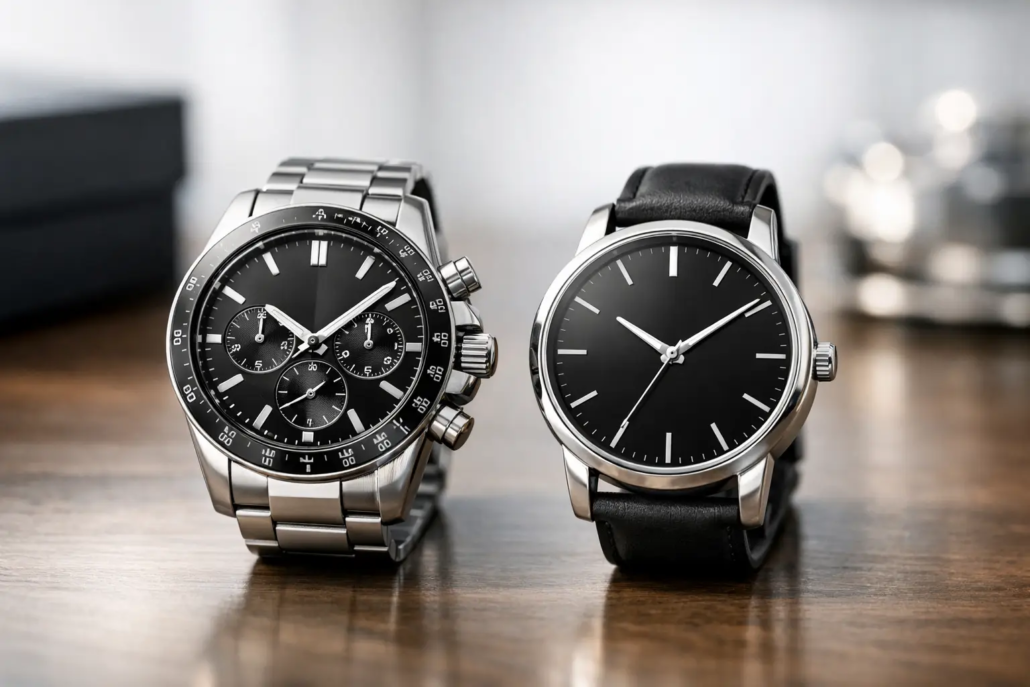
Chronograph Vs Three-hand Watch. Which to choose?
The choice between a chronograph and a three-hand watch seems simple until the watch actually lands on your wrist. A chronograph conveys presence, information, and an immediate technical identity; a three-hand watch focuses all the attention on proportions, the dial, and the quality of its execution. It’s not a question of which is objectively superior, but rather which piece fits your pace, your wardrobe, and the kind of watch you want to keep for years.
For those who buy luxury timepieces, this choice defines much more than just telling time. It determines the case thickness, the movement’s architecture, future maintenance, and even how the watch is perceived in a meeting, while traveling, or under a shirt cuff.
Chronograph vs. Three-Hand Watch: The Essential Difference
A three-hand watch displays hours, minutes, and seconds. It may include the date, power reserve, or even a second time zone, but its visual approach is based on clarity. It is the purest expression of traditional watchmaking: a clean dial, immediate readability, and a design that tends to withstand changing trends better.
The chronograph, on the other hand, adds an interval measurement function. Its pushers activate, stop, and reset a specific hand, while subdials record seconds, minutes, and, in certain calibers, elapsed hours. This complexity transforms the watch into both a tool and an object with greater aesthetic appeal.
The difference is not limited to having two pushers. A chronograph requires more components, a more sophisticated construction, and exceptionally precise adjustment. In prestigious mechanical versions, the chronograph’s operation reveals an essential part of the caliber’s exceptional craftsmanship: the clutch, column wheel, cams, hand jumps, and the feel of the pushers are all part of the experience.
The Three-Hand Watch: Elegance without Excess
A well-executed three-hand watch doesn’t need to fill the dial to convey sophistication. In fact, the most balanced pieces demonstrate that simplification is more difficult than it seems. Every index, every dial finish, the length of the hands, and the bezel profile are showcased without distractions.
It’s an especially good choice for a first quality automatic watch, for those who frequently wear suits, or for anyone who wants a versatile timepiece for everyday wear. A classic model with a blue, black, silver, or white dial can accompany a day at the office, a formal dinner, and a weekend out without losing its cohesive style.
It also often offers practical advantages. With fewer markings and a less dense dial design, it’s easier to read. The case is usually thinner than that of an equivalent chronograph, a crucial factor if you have a smaller wrist or want to wear the watch under your shirt cuff. Mechanically, a simpler construction can mean less complex maintenance, although the final cost always depends on the brand and the movement.
Simplicity shouldn’t be confused with a lack of personality. A three-hand watch can incorporate a high-end automatic movement, a titanium case, an integrated bracelet, a sapphire crystal, or luxurious finishes. In a limited edition, the clean design can even reinforce its exclusivity, because it allows you to appreciate every aesthetic choice without visual clutter.
When to Choose a Three-Hand Watch
A three-hand watch is often the best choice if you’re looking for discretion, proportion, and timelessness. It’s the ideal option for those who want a watch that complements their overall look rather than competing with it. It also makes a thoughtful gift: its aesthetic is more universal, and there’s less risk that a particular complication won’t suit the recipient’s style.
If the goal is to build a collection, this timepiece provides an excellent foundation. A good three-hand automatic can be the everyday watch that allows you to fully appreciate more sporty or complex pieces on special occasions.
The Chronograph: Function, Character, and Sporting Tradition
Few watches project as much energy as a chronograph. The subdials, tachymeter scale, and pushers evoke racetracks, aviation, and professional precision. Even when not used to time a lap or a meeting, its presence conveys an affinity for horological engineering.
Its usefulness is real in everyday situations. It allows you to measure cooking time, a training session, a phone call, or a commute without resorting to your phone. However, the purchase shouldn’t be justified solely by this use. Most owners choose a chronograph for its visual language, the pleasure of operating the pushers, and the technical heritage it represents.
In luxury watchmaking, there is a notable difference between a quartz, an automatic, and a mechanical in-house chronograph. Quartz offers high precision and allows for more accessible purchases. The automatic adds the appeal of a living caliber, powered by the movement of the wrist. A high-end mechanical chronograph, especially one with a column wheel or vertical clutch, occupies a different dimension of complexity and collectability.
This sophistication comes with its drawbacks. The case is usually thicker and the dial more ornate. On smaller wrists, a moderate diameter doesn’t always guarantee a restrained presence, as the lug width and overall height have a significant impact. Furthermore, servicing a mechanical chronograph will require more time and money than servicing a three-hand chronograph.
When to Choose a Chronograph
A chronograph is a perfect fit for those who prefer a sporty, technical, or vintage-inspired aesthetic. It’s a natural choice for motorsports, aviation, or instrumentation enthusiasts, but also for professionals who want a timepiece with more character outside of strictly formal settings.
It can work with a blazer and dress shirt, provided it’s well-chosen. A polished steel case, a balanced dial, and a leather strap offer a different kind of elegance than a three-hand watch: less understated, but very refined. For more casual wear, a metal, rubber, or titanium bracelet accentuates its contemporary and durable side.
Size, Legibility, and Comfort Before Technical Specifications
Comparing functions isn’t enough. Before deciding, consider how the watch looks on your wrist. A 39mm three-hand watch might appear larger than a 41mm chronograph if it has an open dial and a narrow bezel. Conversely, a chronograph with contrasting subdials can be excellently legible despite displaying more information.
The lug width deserves as much attention as the diameter. A case that protrudes from the wrist loses its elegance, no matter how prestigious the model. Thickness also matters: an automatic chronograph can easily exceed 13 or 14mm, while many classic three-hand watches feel lighter and more balanced for everyday wear.
Mentally consider the context of use. For the office and formal events, the discretion of a three-hand watch is usually an advantage. For weekends, driving, travel, and a sportier style, the chronograph offers a distinctive identity that’s hard to replicate. If you’re only going to own one watch, versatility is paramount. If you already have a classic base, the chronograph can add contrast and depth to the collection.
Price and Value: Where the Difference Lies
All else being equal, a chronograph, with the same materials and product family, typically costs more than a three-hand watch. The reason is technical: it requires a more complex movement, more parts, more assembly, and additional adjustment. This difference is reasonable, although it doesn’t mean that every chronograph has more collectible value than any three-hand watch.
The value of a timepiece depends on its caliber, provenance, design, rarity, condition, and the significance of the reference within the brand’s history. An iconic and well-proportioned three-hand watch can be in extraordinary demand. Similarly, a limited-edition chronograph can appeal to a collector because of its dial or its limited production run, beyond its timekeeping function.
When setting a budget, set aside a portion for the long term. Purchasing a prestigious watch includes the possibility of servicing, strap replacements, bracelet adjustments, and maintenance. Choosing a timepiece you’ll actually wear is smarter than paying for a complication that will end up gathering dust in a case.
The Right Choice for Your Collection
The ultimate question isn’t whether you need to measure time. It’s whether you prefer your watch to speak with understated precision or with mechanical energy. The three-hand watch rewards a discerning eye: it showcases proportion, craftsmanship, and an elegance that transcends trends. The chronograph captivates from the first glance: it has history, function, and an unmistakable presence.
At Relojes Exclusivos, a carefully curated selection allows you to compare both approaches among established brands, sports watches, and hard-to-find timepieces. Consider the movement, the thickness, the type of strap, and, above all, the feeling the piece conveys. The right watch isn’t necessarily the most complex or the most eye-catching: it’s the one that will continue to feel like yours every time you check the time.